

As I scrolled through YouTube, listening to reports about the death of Presley Gerber, Cindy Crawford’s son, I kept thinking about how close I’d come to losing my own son.
Something about Presley reminded me of Michael, my oldest. Maybe it was the tattoos on his neck, arms, hands, even his knuckles. Presley had 310, the area code where he grew up, tattooed on his torso; Michael has the state of Texas tattooed on his leg.
At one point, Presley had the word “misunderstood” tattooed on his face. Michael has a sheep on his neck because he felt he was the “black sheep” of the family.
Presley later had his face tattoo removed. Michael still has tattoos on his face. I’ve offered to pay to have them removed, too. He doesn’t want to. They mean something to him. One is a sacred symbol; another is in memory of close friends he’d lost. A third reads “no more pain.” He’s told me he can tell when someone is looking at him and really seeing him, or just looking at his tattoos.
The news reports said Presley had checked into a recovery home shortly before he died. His death was being investigated as a suspected overdose. Hearing that brought back the night in 2018 when Michael checked into Cypress Lakes Lodge, an inpatient rehab facility five hours northeast of our home in Austin.
The intake coordinator searched him and his belongings. Michael later told me he’d smuggled drugs in anyway, tucked into a hidden compartment in his backpack. He relapsed almost immediately after coming home from his thirty-day stay.
A little over a year later, he got off hard drugs. He’s stayed off them for more than seven years now, and the life he has today is beyond anything I could have imagined for him when he was using.
Watching Presley’s “Mental Health Mondays” videos, I kept thinking: Why did Presley die? And why was my son spared?
Then my phone rang. It was my middle son, Ben. He’s twenty-seven, the same age as Presley.
Ben wanted my advice about work. The company he’d recently joined was going through a merger, and some of his close colleagues were leaving. He was wondering whether he should start considering other opportunities.
When Ben asked what I was up to, I told him I’d been listening to reports about Presley’s death and thinking about Michael.
“Yeah, I saw that. Wasn’t his mom a model?”
We talked about Presley’s younger sister, Kaia, and what she must be going through. I told Ben about an interview with her in the September 2026 issue of Vogue, published a little over a month before her brother’s death. In it, she said, “…I started to self-identify as the easy one and never wanted to ask for help. Because it felt like too much to have two children who were needing.”
“Yeah, Joey and I were like that too,” Ben said. “We didn’t want to get into any trouble. You and Dad were already going through enough with Michael. We didn’t want to make things any harder for you.”
Joey is my youngest son, the same age as Kaia. Ben was a top athlete in high school, and Joey was a top student. At the time, I was so wrapped up with Michael that I probably didn’t know they were intentionally staying out of trouble.
Ben brought up Lil Peep and Mac Miller, two other young men who reminded us of Michael. Both were rappers and songwriters who had died of overdoses involving fentanyl during the years when Michael’s addiction was at its worst.
Mac Miller especially reminded Ben of Michael. For one thing, they look more like brothers than Michael and his actual brothers do. Ben talked about how some of Miller’s lyrics foreshadowed his death. It was almost as if he knew he was going to die.
Even after we hung up, I couldn’t stop thinking about the young men we’d talked about, how close Michael had come to being one of them, and how grateful I am that he pulled through.
I went back to YouTube and watched more news reports. One described a fentanyl overdose that had left Presley in a coma for several days. I thought of Michael’s first overdose.
* * *
February 27, 2016.
Before that morning, I thought Michael was getting better. He had been in an intensive outpatient rehab program called Promises, but he’d quit two days before he was supposed to finish. His counselor told me Michael wasn’t out of the woods and still needed additional treatment. The counselor had recommended inpatient treatment and even lined up a bed for him.
Michael didn’t want to go. He had just started a new job and was afraid he’d be fired if he asked for thirty days off. He told us he didn’t need inpatient treatment.
I wanted to believe him.
We were buying him a used SUV to replace the car he had wrecked two months earlier, on Christmas Day. We were supposed to pick it up that morning. The car was meant to be a reward for his progress, and we’d decided to go ahead even though he’d quit the rehab program early. He needed a way to get back and forth to work.
It was a Pathfinder. I loved the name. To me, it meant Michael was on a new path.
Around eight that morning, my husband, James, couldn’t figure out why Michael wasn’t up yet. He thought Michael would be excited to pick up the car, so he went upstairs to check on him.
I woke to James yelling, “Call 911. Call them NOW. It’s Michael, and it’s not good.”
Somehow, I knew immediately what had happened. I grabbed my phone and dialed 911.
“What is your emergency?”
“It’s my son. He’s overdosed. Heroin. Get someone here as fast as you can.”
I ran upstairs.
James was in the bathroom with Michael, who was wedged between the toilet and the bathtub, his body contorted. His feet and shins had a purplish cast, as though the circulation had been cut off. His face was ashen, his lips dark purplish blue. Rust-colored liquid oozed from the side of his mouth.
The 911 operator told me to count his breaths, and I passed that on to James.
But there were no breaths to count.
She began giving me instructions for mouth-to-mouth, which I also relayed to James.
Michael’s jaw was clenched shut. James couldn’t get his mouth open and asked me to get a large spoon. With the operator still on the line, I ran downstairs to the kitchen and grabbed a serving spoon. James used it to pry Michael’s teeth apart and gave him mouth-to-mouth.
We lived near a fire station, and moments later paramedics arrived in a fire truck. They moved Michael to the game room outside his bedroom and began administering Narcan, a medication that reverses an opioid overdose. They worked on him for several minutes.
Joey, a freshman in high school, was at a sleepover, but Ben, who was a junior, was home. Later, Ben would write about that morning in a college application essay. That was how I learned what it had been like for him.
He, too, had been awakened by his father’s yell for help. At first, he waited in the hall outside his bedroom. I remember him coming into the game room and taking a knee, the way his football coaches had taught him to do when another player was injured on the field.
We held each other while the paramedics worked on Michael.
Slowly, Michael began to regain consciousness. He was still pretty out of it when they loaded him onto a stretcher, carried him down the stairs, and put him in an ambulance waiting in front of our house. By then, police officers had arrived, too. Our house looked like a SWAT operation.
While the paramedics settled Michael in the ambulance, the police checked James’s and my driver’s licenses and asked us questions. When they were done, I got in the back of the ambulance for the trip to the hospital. James followed in the car.
Ben stayed behind.
In his essay, he wrote that after we left, he went into Michael’s bedroom and found a needle and a burnt spoon on the nightstand beside the bed.
As the ambulance pulled out of our subdivision onto the highway, I began imagining our family without Michael. What would Christmas be like without him?
To stop my mind from going there, I started rambling. I told the paramedics how, a few weeks earlier, Michael had asked me to buy cannabis oil to help him get through withdrawal. He’d sent me to a dealer’s apartment to pick it up.
As I was leaving the apartment complex, a police car pulled up next to me. The bag with the vial of oil was on the passenger seat. I thought for sure I was busted.
One of the paramedics laughed. “If you had told him the situation, I’m sure he wouldn’t have done anything. This is Austin.”
Then Michael, still strapped to the stretcher in the middle of the ambulance, said, “I’m thirsty. Can I have some water?”
When they told him he would have to wait, he got more insistent, yelling, “GIVE ME SOME FUCKING WATER!”
I was mortified. The paramedics had just saved his life. The least he could do, I thought, was be polite.
At the hospital, Michael was put into a bed in a curtained-off space. A nurse started an IV drip and told us they’d keep him there while he stabilized.
He was sedated when he told me he’d seen “the white light at the end of the tunnel.”
I wondered if, while he wasn’t breathing, he’d crossed over and come back.
We’ve never talked about it since. I don’t know if he even remembers telling me.
Before we left, a hospital social worker gave us information about inpatient rehab programs.
When we got home, I went upstairs with Michael, who was still groggy, to help get him situated. There was a large, dark, wet spot on the game room floor where the paramedics had worked on him. I cleaned the carpet while Michael rested.
I thought surviving an overdose would be enough to make him stop using for good, especially after the near-death experience he had described at the hospital.
But within days, he was using again. He was still able to work and refused to consider the inpatient programs the social worker had suggested.
There would be six more overdoses before he got well.
* * *
Since I first learned about Presley’s death, I’ve been thinking a lot about his mother, Cindy Crawford.
In the late 1980s, long before either of us had children, I used to see her occasionally at Lakeshore Athletic Club on West Fullerton in Chicago, where we both worked out. Her star was just beginning to rise. She was friendly but kept to herself.
I can’t imagine the anguish she must be feeling after losing her firstborn child, her only son. I wonder if she’s blaming herself, looking back and asking what she could have done differently.
I know I did.
For years, I was racked with guilt over Michael’s addiction. I questioned everything, going all the way back to when he was an infant.
I’d returned to work when he was only four weeks old, leaving him with a babysitter for more than ten hours a day, commuting an hour each way, pumping my breast milk in a bathroom stall at the corporate offices where I worked. After Michael became addicted, I wondered whether being away from him so much, so early, had contributed to what happened later.
In a TODAY interview in May 2025, Cindy sat with Presley and Kaia and recalled something Presley had said in preschool. Asked what his parents did for work, he’d told his teachers his mother didn’t work.
“Wow, that means I’m doing a great job,” she remembered thinking, because “he doesn’t feel my absence so much.”
I wished I could have felt that same reassurance.
* * *
Presley’s story brought me back to Michael’s mid-teens and the years before his addiction took hold. Both had gone through major upheavals at that age, though their circumstances were vastly different.
Like infancy, adolescence is a formative time. In Brainstorm: The Power and Purpose of the Teenage Brain, psychiatrist Dan Siegel describes the changes happening in the adolescent brain. Emotions intensify. Young people reach for more independence. Even as they pull away from their parents, they still need to feel safe and understood.
Presley had started working as a model when he was about fifteen. He later talked about giving up surfing when he started modeling. He had loved being in the ocean.
Watching him talk about the ocean, and listening to his “Mental Health Mondays” videos, I wondered what it cost him to give that up at fifteen.
I thought about the word he’d had tattooed on his face. “Misunderstood.”
In another video, recorded when he was an adult, he described taking a cocktail of benzos and other medications. He said he’d seen fifteen different psychiatrists and wanted clearer guidance about how to take what he’d been prescribed.
For Michael, the upheaval was at home.
When Michael was in his mid-teens, James underwent gastric bypass surgery. I had encouraged him to do it. He’d always had severe mood swings, and I wondered whether they might somehow be related to his blood sugar levels. I thought the surgery would help.
Instead, things got far worse.
Over about eighteen months, James went from 360 pounds to 180. He had a large frame, and the weight loss left him looking gaunt and ill.
James had struggled with anger for as long as I’d known him, but in the months following the surgery, his rages grew darker and more frightening.
He was verbally and emotionally abusive to the boys and me. Michael took the brunt of it. I didn’t handle things as well as I could have, but nothing prepares you for being called a “fucking bitch” in front of your children, or worse, hearing your husband call your child a “fucking idiot.”
One incident involving a fly-fishing reel stands out. The reel had been on a shelf in Michael’s bedroom closet for several months. James had put it in Michael’s suitcase as we packed up after a trip to the Grand Tetons. I thought it belonged to Michael and that he was keeping it separate because he prized it. It turned out to be James’s.
At some point, Michael brought it downstairs and put it on the kitchen counter. It sat there for a few days. When James noticed it, he flew into the most bizarre rage I had ever witnessed, accusing Michael of trying to pawn it.
He yelled about Michael’s “druggie friends,” then kicked him out of the house, screaming, “Get the fuck out and don’t come back.”
Michael had just turned fifteen. To my knowledge, he had never even smoked pot and didn’t have any “druggie friends.” He had done absolutely nothing wrong. Nothing.
As always, I stifled my anger.
I got in my car and followed Michael as he walked through the neighborhood in the cold March rain. It took at least thirty minutes before he would get in the car with me, shivering and crying so hard his whole body shook.
Through his tears, he said, “Mom, I’ve never been in a pawn shop in my life, and anyway, I’m pretty sure you have to be eighteen.”
“I know, Michael. I don’t know why your dad acts the way he does.”
Michael had more to say, but he was having a hard time getting the words out.
“Last week,” he started, then paused, and started over. “Last week, when you were in Phoenix for work, Dad kicked me out of the house then, too. He made me promise not to tell you.”
I knew in that instant that my children were not safe at home alone with their father.
We drove home in silence. James didn’t acknowledge us when we got back. Later, he acted as though nothing had happened.
That’s how it always went.
During those years, James also attempted suicide.
Once, I found him passed out, half his body on the foot of our bed and half on the bench beside it. At the time, I just thought he’d fallen asleep in an odd position, but he later told me it was an attempt to end his life.
Another time, I found a loaded handgun under a pile of dirty clothes in our bedroom closet. James told me it belonged to a friend and that he’d brought it home because he planned to kill himself.
Finding that gun and learning what had happened to Michael while I was away on the business trip convinced me I needed to be home. I quit my corporate job and took a recruiting job at less than half the pay so I could work from home and keep an eye on what was happening with the boys.
James was a real estate agent, and his income was highly inconsistent. I was the primary breadwinner. We’d already gone through our savings, and my pay cut left us struggling.
I consulted a family law attorney and seriously considered divorce. The attorney suggested moving out of state with the boys, saying James wouldn’t have the means to fight me.
I thought about it. But I didn’t want to rip Michael away from his friends. And if I divorced and stayed in Austin, I was afraid James would have time alone with the boys when I couldn’t be there to protect them.
So I stayed. Right or wrong, I believed it was the best way to keep my sons safe.
And I regret supporting James’s weight loss surgery to this day. Had I known what we were in for, I would never have encouraged it. You don’t heal old wounds by rerouting someone’s intestinal tract.
What followed was a nightmare for me and our entire family, one that continued long after Michael got well. It’s a big part of why I write under a pseudonym. My sons love and accept their father. They have told me that they have forgiven him, and now they look after him.
Ben and Joey are proud of Michael and what he’s done with his life, but the part involving their father is harder and more private. I need to be careful with a story that belongs to them, too.
I believe the way James treated Michael during those years contributed to his addiction, but I don’t think he intentionally hurt him. He couldn’t control his temper, and I think that comes from what he went through as a child. I also know what it was like to be in that car following my fifteen-year-old son in the pouring rain.
For a long time, I blamed myself for all of it: going back to work when Michael was a newborn, encouraging James’s surgery, staying in an unhappy marriage. I second-guessed those decisions again and again.
Forgiving myself took time. I had to stop judging every decision I’d made as though I could have known then everything I know now.
I now look back at myself as the young mother pumping milk in a bathroom stall, and as the woman following her son through the rain, with love and admiration. I was trying to provide for my family. I was trying to keep my children safe. I can wish I’d done things differently and still recognize how hard I’d been trying.
* * *
Michael’s addiction hadn’t started with heroin. That came later. It began when he was given a thirty-day prescription for opioid painkillers by an emergency room doctor after a relatively minor ankle fracture, one that hadn’t even required a cast.
Around that time, Michael later told me, a high school friend shared Percocet that had been prescribed to a family member who had cancer. Soon afterward, Michael began getting prescriptions by going from one doctor to another.
Later, he bought pills illegally. They weren’t hard to find.
In the early 2010s, the streets were flooded with prescription meds like OxyContin and Xanax. When the pills became too expensive, Michael switched to heroin. His use escalated quickly.
* * *
If Michael was going to get well, he needed something more than the rehab programs were providing. So we sent him to Costa Rica for an iboga retreat. Twice. It helped, but he still relapsed. Both times. Later, he received ibogaine at a clinic in Tijuana.
The terms are often used interchangeably, but they’re not the same. Iboga is the root bark of the Tabernanthe iboga shrub, taken in ceremony. Ibogaine, its main active alkaloid, is extracted and given in a clinical setting under medical supervision. Even though Michael needed multiple treatments to get well, I believe these medicines helped with his recovery.
Presley also underwent ibogaine treatment in Mexico. In a podcast following his death, Dr. Drew Pinsky spoke about some of his patients who had tried ibogaine or ayahuasca. He said he had seen only one case in which someone who worked with those medicines stayed off opioids.
I don’t think his comments give the full picture. For one thing, he lumped ibogaine and ayahuasca together. Ayahuasca comes from South America; iboga is native to West Central Africa. They are different medicines, and they affect the brain differently. Ibogaine can interrupt opioid withdrawal. Ayahuasca isn’t known to do that, although it may help some people with addiction in other ways.
In a recent TMZ interview, conducted just after Presley’s death, advocate W. Bryan Hubbard described ibogaine as a starting point for recovery, rather than a cure. His was one of the fairest accounts I’d heard.
I mentioned Dr. Drew’s comments to Amber Antonelli, whom I first met in 2018. At the time, she and her husband, Anthony Esposito, were just starting Awaken Your Soul, an iboga retreat center in Costa Rica. I was desperate to find help for Michael, and had learned that iboga could help with addiction. He had no interest whatsoever and wouldn’t even discuss it with me.
So, I gave up on trying to get him to go and decided to experience the medicine myself. That way I would find out what it was all about. I did my first iboga retreat with Anthony and Amber that fall.
Shortly after I got home, Michael had a change of heart. Anthony and Amber had no retreats scheduled, so Anthony suggested Iboga Wellness, where he had trained, and helped Michael get in quickly.
I’ve recently reconnected with Amber and am doing her program, From Patterns to Power. During a recent session, I asked what she and Anthony had seen during their years running Awaken Your Soul.
She told me that more than 1,500 people had gone through their retreat center. Many were struggling with addiction, and there were relapses, but there were also plenty of success stories.
These aren’t clinical studies, of course. They’re just anecdotal, but I trust what Amber has to say. She and Anthony have years of experience working directly with the medicine, and I know firsthand what iboga can do. Before my first retreat, I hadn’t acknowledged I drank too much, not even to myself. Iboga helped me face it and recognize that I needed to change. Since then, I rarely drink.
One small observational study found that people had less severe opioid withdrawal and reduced their drug use after ibogaine treatment. So, ibogaine can help, but it also has risks, including the potential to cause dangerous, sometimes fatal, changes in heart rhythm.
Clinics in Mexico, such as Ambio and Beond, use protocols to reduce the risk. These include screening patients before treatment and keeping them under close medical supervision. I hope to see more research conducted in the United States, drawing on what these clinics are learning and also looking at what type of aftercare helps people stay well.
Michael was not treated at Ambio or Beond. He was treated at another clinic. I had been told that staff at the clinic would help with aftercare arrangements. It had all happened so quickly that we didn’t have anything lined up, so while he was there, I was frantically trying to arrange something. I was hoping a counselor would work with us to help coordinate things. That didn’t happen.
Instead, Michael was dropped off in San Diego with another patient. He began using again almost immediately. Within a week, on the summer solstice, he was arrested, which probably saved his life. That’s a story of its own. A few days later, I was able to get him to Hawaii and into a sober living program. Even though he had used after the treatment, I believe it still helped him once he was there.
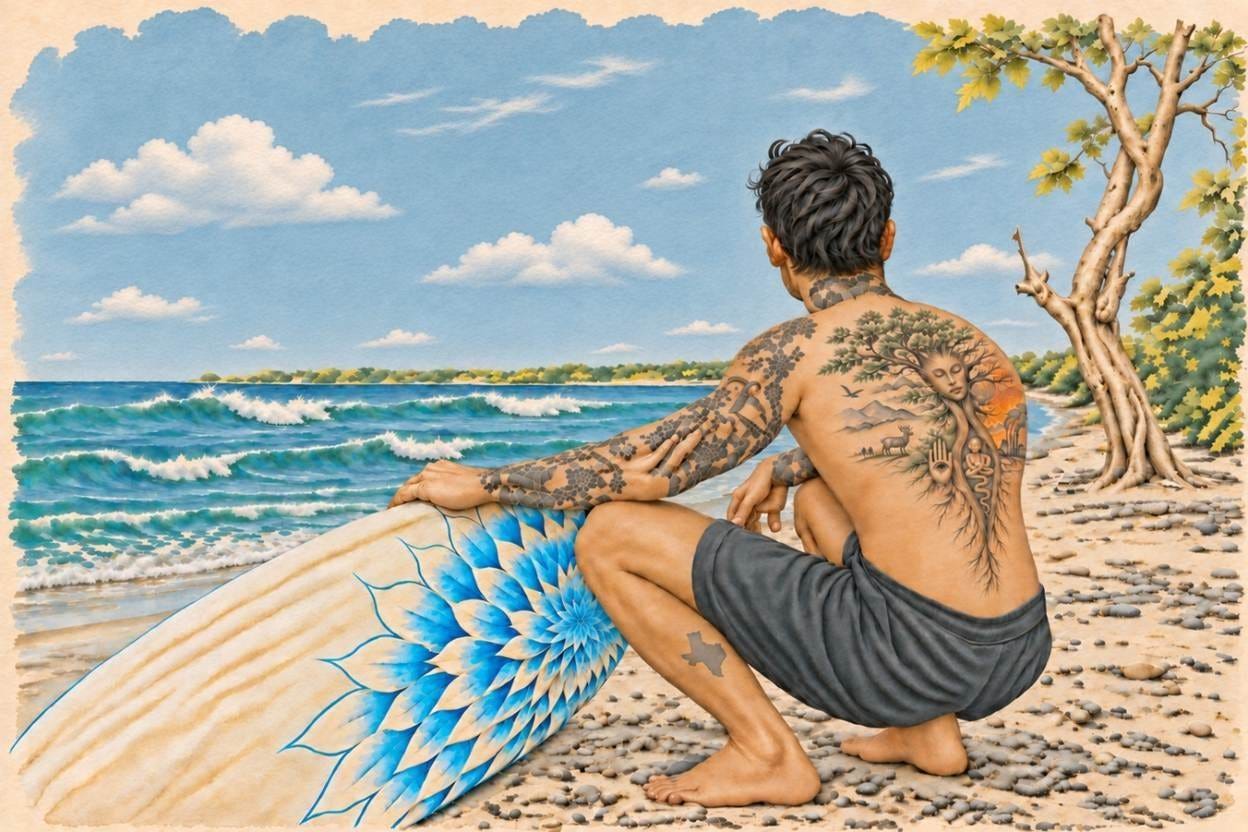
Michael spent seven months in the sober living program, where he had structure and support. The home had a chef who prepared healthy meals. Michael joined a health club where he lifted weights and did yoga. He took pride in his work as a carpenter, earned a good living, and learned to surf.
In Hawaii, far from the places and people he associated with using in Austin, Michael had time to find his footing.
* * *
During Michael’s first months in Hawaii, I was still trying to understand what we’d been through together.
Astrology had never interested me. After attending a workshop on Vedic astrology on a whim, I began wondering whether it might help me understand some of what I’d experienced with Michael. To learn more, I read Richard Tarnas’s The Passion of the Western Mind, followed by Cosmos and Psyche. After reading both books, I was beginning to think there might be something to astrology after all.
Still curious, I sought out astrologers and discovered Heather Ensworth, a clinical psychologist, astrologer, author, and shamanic practitioner. Through her books and YouTube channel, she speaks about humanity going through an upheaval as one great astrological cycle ends and another begins. She believes we are evolving toward greater love and awareness of our connection to each other and the cosmos.
I asked Heather to read Michael’s birth chart and mine. I hadn’t told her anything about our story. All she had were our birth dates, times, and places.
After analyzing our birth charts, she told me Michael and I had been connected in previous lifetimes and had come together again to help each other’s souls grow. In his chart, she pointed to patterns she associated with his fractured relationship with his father, his addiction, and even his recovery.
She pointed out another pattern in Michael’s chart and told me she was seeing something similar in the charts of other young men. She believed they were old souls who had come into the world at this time to help humanity evolve. Many, she said, were becoming overwhelmed and turning to drugs.
Years later, after that phone call with Ben about Presley, I got curious about Mac Miller and Lil Peep and did a little digging. I found an interview with Peep where he spoke openly about his anxiety and drug use. Young fans wrote to thank him for understanding what they were going through. Mac, talking about his album The Divine Feminine, said he wanted “to connect with the universe through love.”
In that same Vogue interview where Kaia described becoming the easy child, she called Presley “this absolute teacher.” To her, his willingness to share his struggles was a way of saying, “I’m gonna be very human for everyone.”
And I think about what my own son has taught me.
When Michael explained his tattoos to me, he told me how he could tell whether someone was really seeing him. I’ve had to ask myself how often I’ve looked at someone and thought I knew all I needed to know. How often have I been the person who didn’t look any further?
For years, long before Michael’s addiction, I was searching for a way to heal. I had to face things in myself and our family that I hadn’t known how to face. I sought help I once would have dismissed. I had to get stronger before I could help anyone else.
Michael did the work himself. In trying to help him, I got better, too.
So much of what I believed when this began has changed.
Heather’s words are still with me. I’ve come to see Michael, and now Presley, Mac Miller, and Lil Peep, as messengers, souls who came here at this time to help humanity evolve. When I listen to them speak openly about pain that others recognize but struggle to put into words, I hear their desire to help.
I wish Presley, Mac, and Peep had lived to find out what else was possible for them. I think about everything Michael would have missed if he hadn’t survived. And everything we would have missed with him.
By Christmas 2020, eighteen months after he’d moved to Hawaii, Michael was living in a beautiful condo on a cliff overlooking Kailua Bay. That year, he hosted us. We’d arrived just in time to watch the great conjunction of Jupiter and Saturn from his balcony on the winter solstice. With Michael doing so well, it felt like the beginning of a new era.
For the first time in years, I knew he was going to make it.
After breakfast on Christmas morning, we went down to the ocean and watched him surf with his friends.
When I listen to Presley talk about how much he loved the ocean, I picture Michael surfing that Christmas morning. He’s a father now and owns a thriving construction business. Yet there were years when I could barely imagine him surviving another week.
I still can’t answer the question I asked while watching Presley’s videos: Why did he die, and why was my son spared?
But I can do something with the years Michael and I have been given.
Somewhere in the Texas Hill Country, I want to help build the kind of place I spent years wishing I could find. It would be a place for families, because the one with the addiction is not always the only one who needs help. I know how much support I needed.
For someone like Michael, it would bring together what we’re learning about ibogaine treatment for addiction and the kind of long-term structured living environment that helped him in Hawaii. Therapists would help people understand the pain beneath the addiction. People who know recovery firsthand would be there for the hard days.
For others, I’d like to see the day when the center could offer iboga legally, just for psycho-spiritual growth, like Amber and Anthony did at Awaken Your Soul.
There would be a regenerative farm providing the healthiest possible food for the residents and guests. The people who live at the center long-term would also help run it as they are able, working on the farm, preparing food, tending to the grounds, and cleaning the guest rooms.
It would be available to people who can’t afford to pay, but it wouldn’t only be a charity. The guests who come for psycho-spiritual retreats would bring in money from the outside to help cover expenses.
The first center would be a prototype. The grand vision is that some of the people who get well there and learn how it runs would go on to seed other centers around the country, and maybe eventually around the world.
I got to see the man my son became. I want that for other mothers.
Thanks for sharing this. I’ve just read Presley’s story as well, and it’s so heartbreaking. The idea that these boys are old souls is comforting in a way.
I’m sorry your family went through this and love the idea of building something in the US that supports families.
Thank you for sharing your journey. Its heart wrenching and real and a problem today in society. So many are affected! It's beautiful to hear that your son came out of it and I understand trying to make sense out of it..