

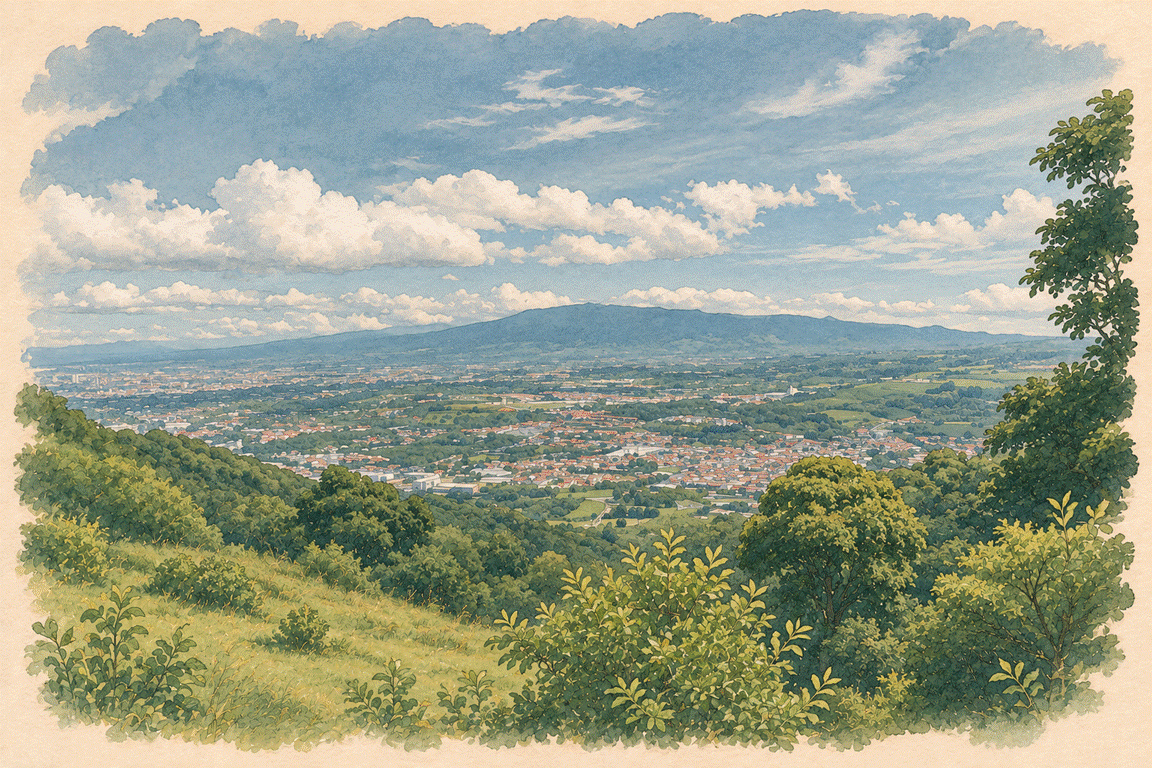
From the top of the wooden platform at La Carpintera, you can see the Poás and Irazú volcanoes, the Tres Marías Hills in the distance, and Costa Rica’s Central Valley below. When you step off, the rainforest canopy rushes by beneath your feet. I was fifty-nine. My middle son, Ben, was twenty-two.
Three years earlier, I would never have considered hanging from a thin cable 150 feet above the earth. But I was learning to face my fears. Besides, the zipline was nothing compared to what was coming next.
It was early August 2021, two weeks before Ben was to begin his senior year of college. We were in Costa Rica for a psycho-spiritual retreat with iboga, a sacred plant medicine made from the root bark of Tabernanthe iboga, a small shrub that grows wild in West Central Africa.
The Babongo, Mitsogo, and Fang, indigenous forest peoples of Gabon and Cameroon, have long used iboga in initiation ceremonies and other spiritual practices. A gift that is now being shared with the rest of the world, iboga is central to the Bwiti tradition, which incorporates animism (the belief that everything has a spirit), reverence for ancestors, and wisdom gained through experiences with iboga. Some branches incorporate Christianity as well. Because iboga offers profound and life-changing insights, it is sometimes called “the master of all teacher plants.”
Ours was not exactly a typical mother-son vacation, but I felt the experience would be the perfect rite of passage before Ben graduated from college and moved into the working world. And he was up for the adventure.
We finished ziplining around noon and headed back to our hotel in San José for a quick lunch. Afterward, a white passenger van was waiting for us out front. As we left the wailing sirens and honking horns of the city behind, the landscape turned to rolling green hills and hazy blue mountains.
Every so often we passed a roadside stand selling plantains, bananas, coconuts, or starfruit. At one point the driver slowed down so we could get a better look at a pair of sloths hanging in a tree beside the road.
About an hour later, we turned off the highway onto a steep dirt road. Half a mile up, hanging on an open metal gate, was a sign hand-painted with a yellow sunburst and the words “Awaken Your Soul.” We had reached our destination.
At first glance, the place looked like a tropical wellness spa, but it was a sanctuary for iboga plant medicine retreats. Ben and I got out of the van, collected our suitcases, and were greeted by Anthony Esposito and Amber Antonelli, the husband-and-wife team who ran the place. The impeccably maintained grounds were lush with palms, ferns, and red and orange heliconia. Toucans and parrots perched in the trees, while hummingbirds and butterflies fluttered closer to the ground.
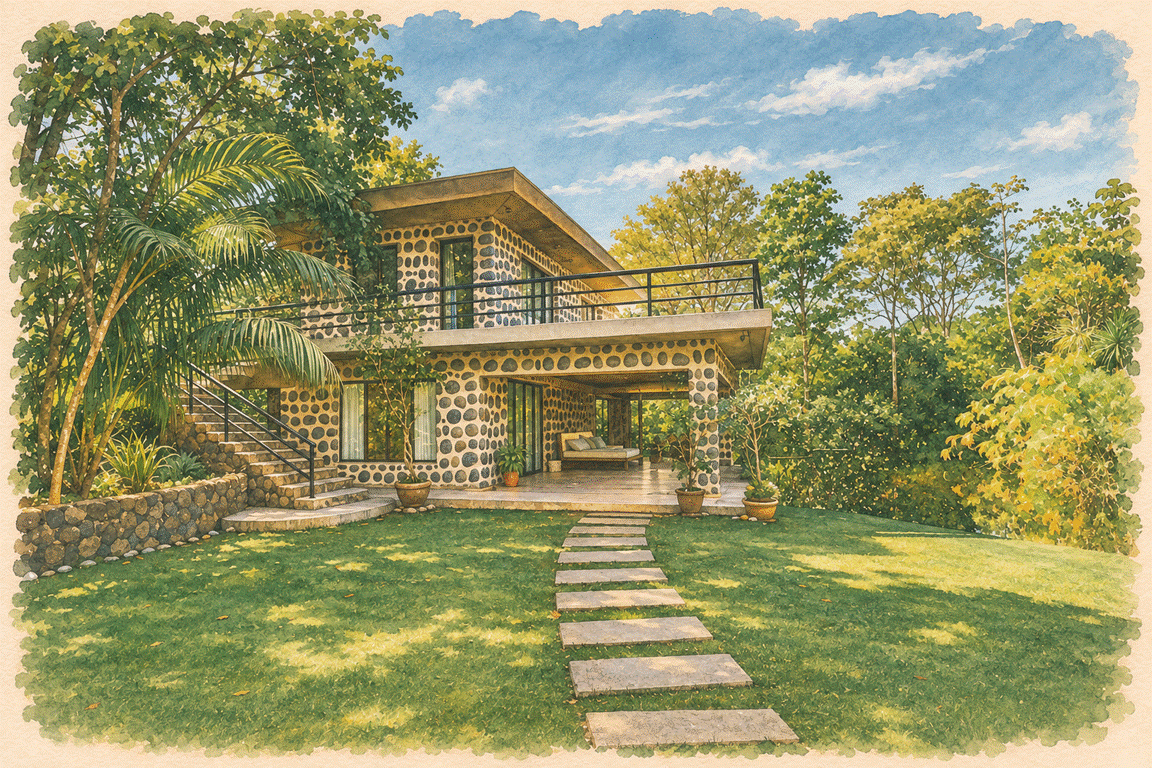
Anthony led us to our rooms in rustic, tile-roofed stone buildings clustered near the center of the property. We put away our things, then joined the other guests to meet Anthony and Amber at the fire circle near the covered outdoor terrace where the ceremonies would be held. Wearing only a diaper, their two-year-old daughter led the way.
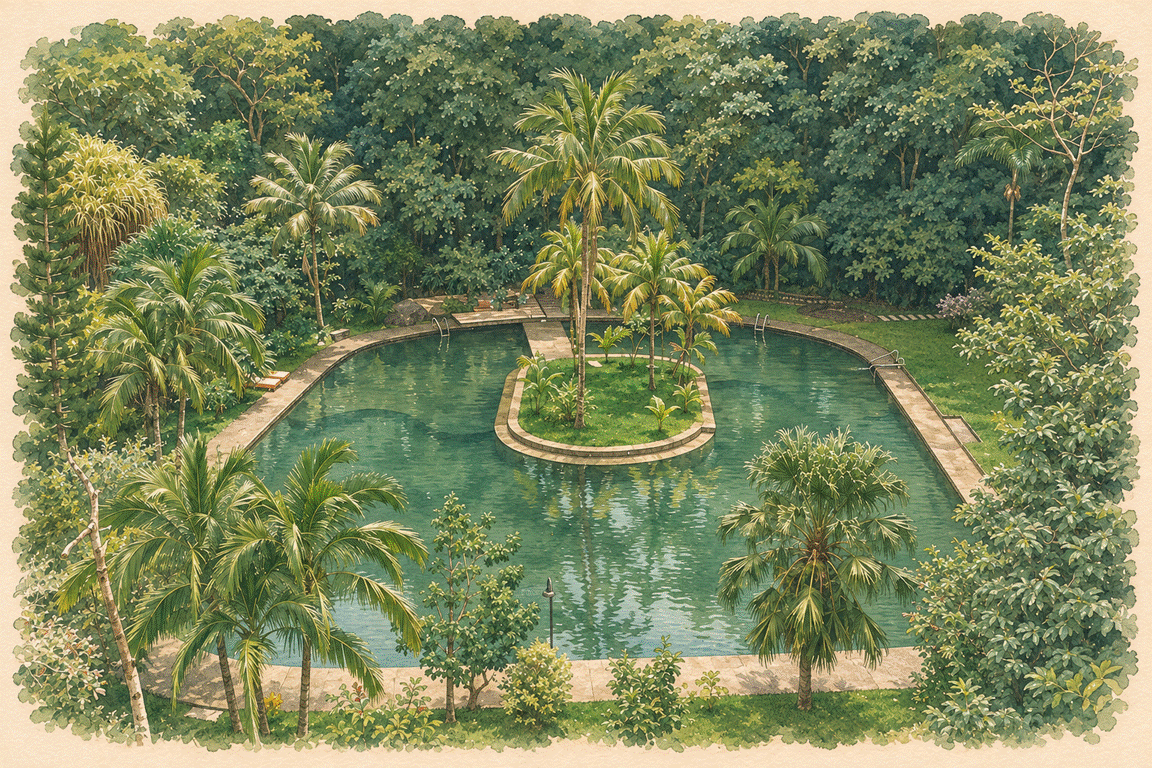
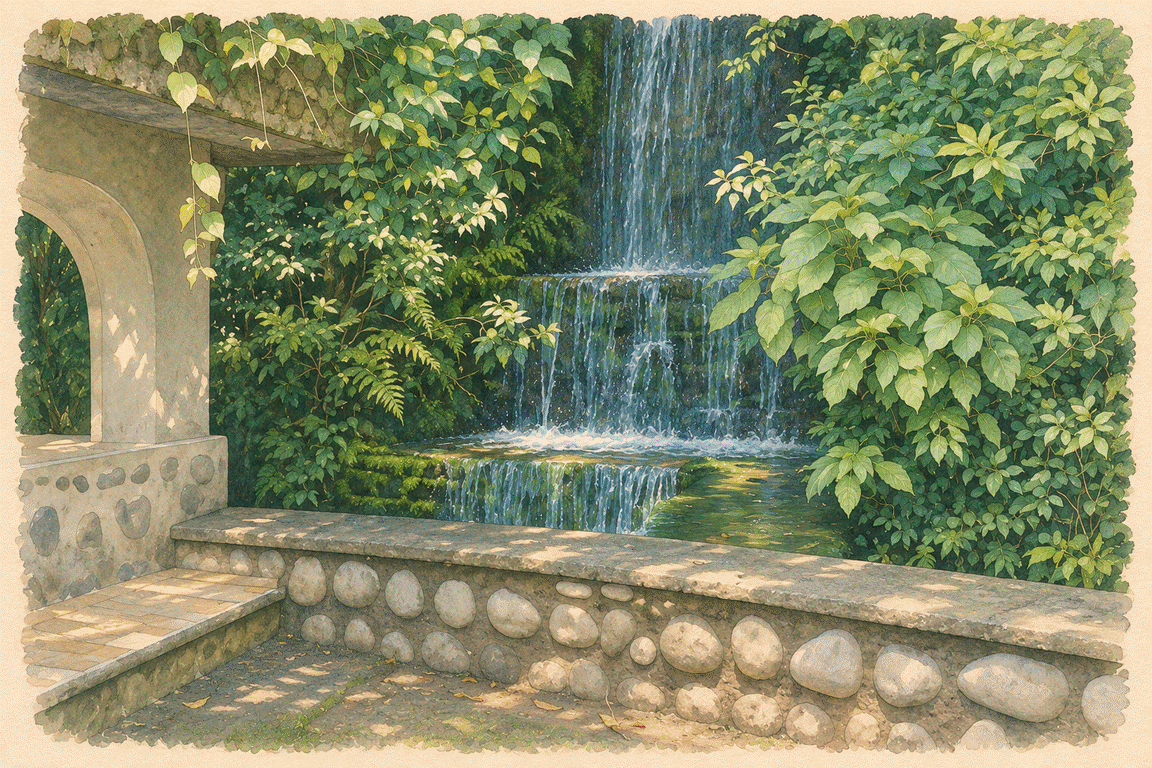
After that, Anthony and Amber showed us around the property. The terrace overlooked a large natural swimming pool with an island in the center. Behind the pool, directly in front of the waterfall that feeds it, was a small open-air stone pavilion with a table where guests could receive massages while being lulled by the sound of water rushing down from the mountains above.
The tour ended at the communal dining area, a patio overlooking a lily-covered koi pond, where we enjoyed a “plant-forward” gourmet meal, served alfresco. The food, made from locally sourced organic produce, was prepared by chefs trained by Amber, who had run a culinary business in Austin, Texas, for many years before she and Anthony moved to Costa Rica to host iboga retreats full-time.
As we took in our surroundings, I felt at peace with my decision to bring Ben with me. It was apparent that Anthony and Amber took a lot of pride in getting every detail right to create a safe, healing environment for their guests.
It was not a decision I had made lightly. My husband had questioned it. He said that with Michael, our oldest son who had struggled with heroin addiction for years, he understood. We had run out of options. But why Ben? Ben did not have substance abuse issues. He got good grades, had a wide circle of friends, and was well-adjusted.
In the West, iboga is best known as a treatment for addiction. But in the Bwiti tradition, it is also used for spiritual growth and as a rite of passage into adulthood, which seemed right for Ben’s stage of life. And I knew what it could do.
The retreat with Ben was not my first encounter with iboga. That had happened three years earlier, and with the exception of the births of my three sons, it was perhaps the single most meaningful experience of my life. It was also one of the most challenging. Iboga is not for everyone, and it is certainly not for the faint of heart.
I had learned about iboga while searching for a way to help Michael. As it so often does, his addiction started with a prescription: opioid painkillers from an ER physician for a relatively minor injury when he was in high school. Physical dependence and his heroin use didn’t set in until a few years later, but that ER visit, I’m convinced, is where it began.
Iboga is the root bark itself, ground to a fine powder, something like sawdust, and taken in ceremony. Ibogaine, its main active alkaloid, is extracted and given in a clinical setting under medical supervision.
When I first read about them, I wasn’t sure either would be suitable for Michael, and I certainly wasn’t considering doing iboga myself, even though I had already worked with ayahuasca. There were stories on the internet about people who had died from ibogaine treatment. That scared me. And both iboga and ibogaine are illegal in the US, so getting treatment meant traveling to a country where it is allowed.
Michael was not open to it anyway. He wouldn’t even discuss it with me.
Over the next couple of years, addiction continued to ravage Michael and our family. His struggle escalated almost to the point of no return. He had been in two intensive outpatient and two residential rehab programs, one of which lasted ninety days and was followed by four months in a sober-living arrangement in Kerrville, a small town about a two-hour drive from where we live in Austin. He relapsed soon after he moved back.
In addition to the sober-living and rehab programs, Michael had participated in countless AA and NA meetings, gone to addiction counseling, and received psychotherapy, EMDR, neurofeedback, and equine therapy. He had been on Suboxone, a maintenance drug whose main ingredient, buprenorphine, is itself an opioid. Buprenorphine has a longer half-life than heroin and can also cause physical dependence. Suboxone helps many people and has been shown to reduce overdose deaths, but it didn’t help Michael, and it was one more thing to come off of.
He had also been prescribed Vivitrol, a monthly injection that works by blocking opiate receptors in the brain, so if Michael used heroin or other opioids, such as OxyContin, while on Vivitrol, they would have little or no effect. He told me he tried anyway. That is one of the dangers of Vivitrol: taking more to get past the blockade can cause a fatal overdose.
Although Michael’s main drug was heroin, which is often laced with fentanyl, an opioid many times more potent than morphine, it was not the only drug he used. After becoming addicted, he also abused alcohol, crystal meth, cocaine, and Xanax.
Before the ninety-day program, while he was on Vivitrol, he used just about anything he could get his hands on except heroin and other opioids, often in dangerous combinations. And while Vivitrol did block the heroin, it did little to heal the underlying causes of his addiction.
None of his attempts to overcome addiction worked for long. He would do better for a while and then relapse. With each relapse, it seemed, he fell harder and faster.
If we didn’t figure out how to help Michael heal, he was going to die.
According to a report by the International Center for Ethnobotanical Education, Research and Service (ICEERS), iboga and ibogaine can help people interrupt opioid addiction. However, they are not without risk. People have died during ibogaine treatment. The drug can cause dangerous changes in heart rhythm, even in people without a known heart condition, and certain other drugs can increase that risk.
Careful screening and medical monitoring reduce but do not eliminate the risk, and ibogaine clinics like Ambio and Beond now do both. Heroin and fentanyl, meanwhile, kill tens of thousands of Americans every year. But in 2018, all I knew were the stories I’d read on the internet.
Out of sheer desperation, I took a second look anyway. I went back to my research and found Awaken Your Soul’s website. As I read, I learned that Anthony is a Bwiti initiate with several years’ experience serving iboga in a ceremonial context. (Amber has since also become a Bwiti initiate.) It turned out that Anthony and Amber lived in Austin, too, and traveled back and forth to Costa Rica.
After several phone and email conversations with Anthony, I was hopeful iboga could help Michael, but I wanted my husband’s buy-in, so I arranged for the two of us to have dinner with Anthony and Amber. Michael didn’t join us because he was in a court-ordered inpatient program at the time, rehab number four. By then, I wasn’t optimistic that another rehab would help, but since he would be clean when he finished the program, my hope was that he would go straight from there to Costa Rica for an iboga retreat.
Over a dinner of fish and pasta at a quiet restaurant on Austin’s east side, Anthony, who is soft-spoken but comes across as confident and wise, told us about the childhood trauma that had led to self-destructive behaviors, including addiction, from his late teens into his early thirties. He recovered through his work with iboga. He went on to study with a Bwiti shaman from Gabon and then fine-tuned his skills as a healer by working for several years at Iboga Wellness, another iboga center in Costa Rica, before starting Awaken Your Soul with Amber.
Anthony explained that his retreats were strictly psycho-spiritual and not for drug detox. (He told us he could recommend other facilities if Michael needed detox.) He also emphasized that the retreat is only the beginning. It’s the work you do afterward that matters most for deep healing and long-term recovery. He suggested a coaching program called Being True To You, which helps people integrate their experiences with iboga and ibogaine, and a residential aftercare program in Austin run by a psychotherapist trained in psychedelic-assisted therapy.
After meeting Anthony and Amber, I was even more optimistic that iboga, especially with the kind of aftercare Anthony suggested, could help my son. Michael still had no interest. He came home from rehab on a Thursday afternoon, put his things on his bed, and left. By dawn on Saturday, I was picking him up in downtown Austin, high out of his mind on LSD. Thank God he called me.
I gave up trying to convince him and decided to go to Costa Rica to experience the medicine myself. That way, I could find out what it was all about. Perhaps I would get some healing too. And so, during the last week of September 2018, that’s what I did.
At the time, Anthony and Amber didn’t yet have the property Ben and I would visit three years later. They rented another facility in Costa Rica by the week, sometimes working with other practitioners. The week I went, they were co-facilitating with Tricia Eastman and her partner Joseph Barsuglia, a clinical psychologist and ibogaine researcher who is now an advisor to Beond.
I had come across Tricia’s writing on iboga and ibogaine during my research. She has since written Seeding Consciousness, the best guide I have read on sacred plant medicines, especially iboga. She respects the traditions these medicines come from, and she writes from her own experience, including her Bwiti initiations in Gabon.
Like Anthony, Tricia treats the ceremony as the beginning. The most important part is carrying the teachings of the medicine, and of the wisdom traditions that go with it, into daily life and living them.
Before my first retreat, I was racked with anxiety, guilt, and intense shame for what I perceived as my utter failure as a mother, and worn down by a marriage that had been difficult for a long time. I dreaded the sound of my cell phone ringing, always fearing the worst: a call to tell me that Michael had been arrested, again, or wrecked his car, again, or overdosed, again… or worse.
To numb myself, I had been drinking a glass or two of wine (and sometimes the whole bottle) several nights a month. Emotionally, I was a wreck. Physically, I had chronic neck and shoulder pain, frequent headaches, stiff joints, and skin rashes. I was also out of shape, overweight, and craved sugar and starchy foods. I had trouble falling and staying asleep.
The iboga retreat I attended in 2018 changed all that. One week and two ceremonies later, I was on my way to a healthier life, and I am still on that path.
Iboga is a plant teacher, and during my initial retreat, its first lesson was to show me I had been living in fear. Then it taught me how to face my fears and learn from them. My mind would spin worst-case scenarios about almost anything, but especially about Michael. That wasn’t helping him, and I was destroying my own well-being. Iboga also showed me that I had been treating Michael like a child instead of the twenty-five-year-old man he was. That wasn’t helping anyone either.
The most significant transformation after the first retreat, though, was my relationship with alcohol. That surprised me because, at the time, I hadn’t acknowledged I drank too much, not even to myself. Not only had I been using alcohol for years to ease my pain, but in doing so I had set a poor example for Michael.
Since then, I rarely drink and no longer use alcohol as a way to escape my problems. I now see pain as a powerful messenger, signaling that something needs to change. The sting of touching a hot stove tells us to pull our hand away before we get burned. Likewise, emotional pain lets us know we need a course correction. By numbing myself, I was missing the message.
Iboga didn’t fix all of my problems overnight, but it put me on a new path. The hardest things I have ever faced were still ahead of me. What has changed is how I meet them.
The change shows in my body, too. Eight years later, as I write this, I am healthier than I was before I went. Most of the physical symptoms are gone: the headaches, the rashes, the extra weight. I have a consistent yoga practice and have added resistance training. I still have the neck and shoulder pain, some of it from long hours at a computer and some of it, I suspect, from age. I sometimes wonder whether more work with iboga would help with that, too.
* * *
Back in the fall of 2018, shortly after I got home from my first retreat, Michael had a change of heart and agreed to have dinner with Anthony, with the stipulation that I not be there. I’m not sure what they talked about, but Michael called me afterward to tell me he would go to Costa Rica for an iboga retreat. Anthony suggested Iboga Wellness, where he had trained, and helped Michael get in quickly. He went in November 2018 and again in February 2019. He received ibogaine treatment under a doctor’s care at a clinic in Tijuana, Mexico, in June 2019.
I don’t mean to paint an overly rosy picture. Just as my awakening has been gradual, Michael’s recovery after working with iboga and ibogaine was not instantaneous either. His experiences at Iboga Wellness were positive, and afterward he worked with a coach from Being True To You, the program Anthony had recommended. Even so, he relapsed.
The treatment at the ibogaine clinic in Tijuana did not go well, although I don’t entirely fault the clinic. Michael’s experience there was complicated. At the time of his treatment, he had been abusing multiple drugs, including heroin, cocaine, and Xanax.
Staff at the clinic released him alongside another patient and drove the two of them across the US border instead of making sure Michael was safely on his way to aftercare, as I had been promised when I arranged to send him there. When I realized he wasn’t going to aftercare, I made a hotel reservation for him in downtown San Diego. I at least wanted him to have a safe place to stay. That is where they dropped him off.
Michael later told me that after the treatment he was still experiencing intense anxiety and cravings, possibly due to his Xanax use. His tolerance was also gone, which left him extremely vulnerable to overdose.
Although he was in California, where he knew no one, Michael managed to connect with a drug dealer. He began using again almost immediately after his release and, within a week, overdosed twice in a single day. That night, the summer solstice, he was arrested, which probably saved his life.
I was in New York at the time with Ben and my youngest son, Joey. I sent them home and made a frantic cross-country flight to California. Getting Michael released, and then to safety, took the grace of God and a series of miracles. That is a story of its own, and I’ll tell it another time.
A few days after his arrest, Michael and I were on a plane to Hawaii, where he moved into a sober-living home and stayed for seven months. He found work as a carpenter, learned to surf, and turned his life around.
He has been off hard drugs since he moved to Hawaii that summer. That was more than seven years ago. As Anthony told us, it’s the work you do after the medicine that matters most. That was certainly true for Michael. For me, it has become a lifelong journey.
Despite the relapses after the retreats in Costa Rica and what happened following his release from the clinic in Tijuana, I believe Michael’s work with iboga and ibogaine contributed to his recovery.
Once Michael was settled in Hawaii, I spoke with Joseph Barsuglia about what had happened. Joseph told me that even though Michael used again in the week following his treatment, noribogaine, the longer-lasting active metabolite of ibogaine, would still have been in his system and likely played a part in how well he did once he moved into the sober-living home.
Joey, who studied the neuroscience of addiction in college and went on to medical school, told me he believes an important factor in his older brother’s recovery was the new environment.
It seems to me that it was the combination that gave Michael what he needed to overcome his addiction: the ibogaine, a structured living arrangement far from the triggers he faced in Austin, and finding meaningful work he was proud of. Perhaps learning to surf helped too.
Today, Michael is not just surviving. He is thriving. We both are. It’s a miracle that is still unfolding, and my son’s life is unrecognizable from the one he was living in the depths of his addiction.
But Michael’s addiction was never the whole story.
The trauma in our family didn’t begin with him. I lived with it for most of a long and difficult marriage, and I watched what unhealed trauma did to the man I married and to our family. And I had my own wounds from childhood. I don’t think my husband and I would have ended up together if I hadn’t.
For a long time, my dream was that our whole family, my husband and Michael included, would experience iboga together. In It Didn’t Start with You: How Inherited Family Trauma Shapes Who We Are and How to End the Cycle, Mark Wolynn writes that the firstborn son often carries what remains unresolved with the father, an idea that made sense to me. That was one reason I hoped my husband and Michael, in particular, could do this work together.
I had started working on myself years before Michael’s addiction surfaced, in talk therapy mostly, but also by reading everything I could find about trauma and its long-term effects. I began to have a deeper understanding of it, but I hadn’t found a way to overcome it.
All that reading changed how I saw Michael’s addiction, though. I understood it as the result of unresolved family trauma rather than a lack of willpower or a character flaw, so I didn’t blame him. This perspective changed how I approached helping him.
The old adage, “You’ve got to let them hit rock bottom,” never resonated with me, because I knew “rock bottom” might mean death. I never stopped believing that Michael would get well, and I was not going to give up on my son. That is why I turned to iboga and was even willing to do it myself.
It was because of Michael that I found what finally helped me: sacred plant medicine, combined with coaching and talk therapy. I started with ayahuasca, which opened me to new perspectives, but it was iboga that helped me with the deeper work.
What I’ve come to understand is that when there is a crisis like addiction in a family, the whole family needs help. Mine certainly did. I found help, and I believe that made a difference for Michael too. For whatever reason, my husband could not find his way to it, and years after Michael had gotten well, he tried to end his life. There has to be a way to reach men like him before it comes to that. That is the idea behind family healing centers, places where a whole family can go to heal together.
It is hard for me to write about this, because he is my sons’ father, and because I know how much pain he was in. But it has to be okay to talk about things like this. In the weeks before his attempt, the trauma he had carried for most of his life finally caught up with him, and he could not face it. It was worse than anything I could have imagined. What I learned in those weeks was traumatic for me too. I had been trying to help him for a long time. I did everything I knew to do before I accepted that I could not do it for him.
No one should have to go through what my family did. The dream of healing centers comes from what I lived through. It still matters to me, even though my marriage did not survive.
I picture a place where someone whose addiction is as entrenched as Michael’s was can stay as long as it takes to heal, which for him would have meant months, with a regenerative farm and the things that made the difference for him in Hawaii: a structured place to live, meaningful work, and, in his case, surfing.
And the one with the addiction is not always the one who needs the most help. The rest of the family would come too, and stay as long as each of them needed, or as long as they could. When they went home, they would keep coming back, the way we did when Michael was first in Hawaii, so that no one felt alone.
I think there could be a role for iboga and ibogaine in those centers, though I would like to see research on helping families heal before I say so with any certainty.
Research on ibogaine is gaining new support in the US. In 2025, through the Texas Ibogaine Initiative, the state committed $50 million, to be matched by private funding, to clinical trials of ibogaine for addiction, PTSD, and traumatic brain injury at UTMB, UTHealth Houston, Baylor College of Medicine, and other Texas institutions.
But I believe iboga and ibogaine have far more potential than that. My dream is that they will also be studied for psycho-spiritual growth, which is well outside the boundaries of conventional medicine. Perhaps if enough people like me share our stories, they will gain wider acceptance. And I hope that as the research goes forward, in Texas and beyond, the traditions they come from are not left behind.
What I can say is that iboga did more than make me face my issues. It helped me reframe them in a way that loosened their hold on me, which is perhaps why it is called the master of all teacher plants.
* * *
Shortly before Ben and I went to the retreat, I saw an interview with Rick Doblin, the founder of the Multidisciplinary Association for Psychedelic Studies. In it, Rick envisioned a future in which psychedelic therapy would expand to include patients’ families.
Eight of the twelve participants at the retreat Ben and I attended were part of family groups. Carmen, a mother from Spain, was there with her daughter, Elena, and son, Diego, both university students and roughly Ben’s age. Carmen was there for the same reason I was: to share a spiritual experience with her children.
Another family group included Nate and Jess, a couple from New England. Nate had done an iboga retreat at Awaken Your Soul in 2019 to deal with his drinking. He had such a life-changing experience that he returned with his younger brother, Cody, who was recovering from addiction to heroin and Xanax. Jess was there to support them both.
Matthias, a psychiatrist from Switzerland, was back for his third retreat. He was there alone this time, but both he and his wife had been at my first retreat. He told me they had come back in 2019 with their daughter, who was twenty-two at the time. Yet another family doing iboga together.
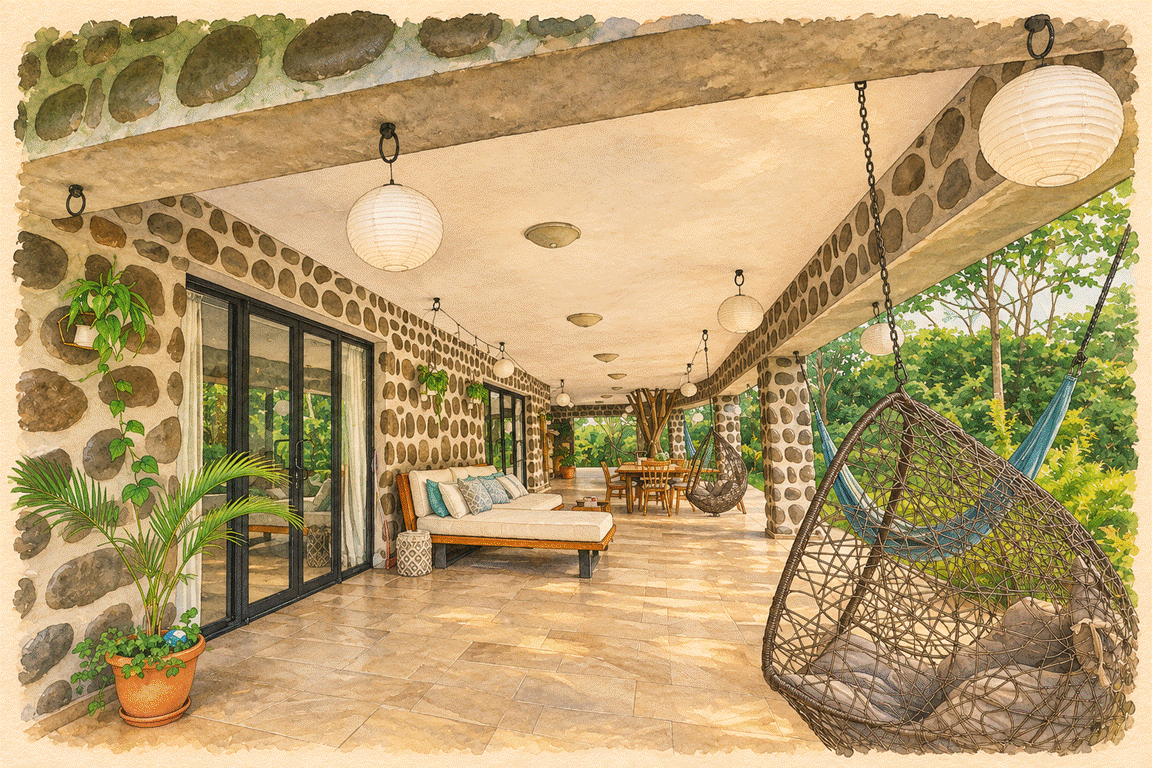
All twelve of us would go through the two ceremonies together. Before the first ceremony, Ben and I each had an EKG to check our hearts. On ceremony nights, which last from dusk to dawn, the terrace was set up with twin-sized mattresses, one for each of us to lie on while we journeyed.
The day after a ceremony, which Amber and Anthony called discovery day, was spent in quiet introspection, usually without sleep, going over the teachings and insights from the night before. Our week consisted of two ceremony nights, each followed by a discovery day.
In the Bwiti tradition, fire is an integral part of initiation rituals. It illuminates the space and is considered a portal to the spirit world: smoke is a protector that provides a runway for spirits to enter and assist, and flames symbolize burning away whatever no longer serves us.
Music is just as essential. All night, the terrace filled with the hypnotic beat of Bwiti drumming, which pulls the mind away from the ego’s chatter and lets you go deeper into the medicine. Anthony had pointed out the speakers on the terrace’s dark wooden ceiling beams, and I sensed it had taken some engineering to get the sound right in an open-air space.
Doing the medicine is hard work. For me, the ceremonies were physically and mentally exhausting. The vomiting was intense, and my visual and auditory hallucinations were terrifying, especially during the first retreat. Yet that is how I learned to face my fears. It is all part of the process.
Ben and I both had good experiences, though mine was not nearly as intense as the first time. On discovery day, sitting in the circle, Ben said he had even enjoyed parts of the night. Everyone laughed. That is not something you often hear about an iboga ceremony.
And the massages in front of the waterfall were one of the highlights of the week. The massage therapist was a petite woman with deep brown eyes and surprisingly strong hands. I asked her to focus on my neck and shoulders. As she worked on me, I could feel the tension releasing down my back and legs and out through my feet. I don’t know how she did it.
On one of the days, Ben had a massage just before mine. The therapist asked me, in English with a heavy Costa Rican accent, “Ben, he is your son? How old is he?”
“Yes, Ben is my son,” I replied. “He is twenty-two.”
“My son is twenty-two also,” she said. “I plan to bring him here to do the medicine with me as well.” Another mother and son doing iboga together. It has been years since Rick Doblin made his prediction, and families doing medicine work together still isn’t common. I would like to see that change. For one week in Costa Rica, it already had.
On our way home from the retreat, Ben told me he wanted to come back every few years, or whenever he needed a “reset.” So did I. Neither of us has.
Anthony and Amber closed Awaken Your Soul in 2024 and moved home to Austin, where I am working with Amber now in a coaching program. What she and Anthony built in Costa Rica is still with me, though. Much of what I envision for the iboga part of the healing centers, I first saw there.
When I think of the woman who dreaded the sound of her phone ringing, I feel compassion for her now, and sometimes even admiration. I am more at peace than I have ever been, and better able to meet whatever comes next, not despite everything I have been through but because of it.
And if my life changes as much in the next few years as it has since my first experience with iboga, then, like that morning in the canopy at La Carpintera, I’m in for quite a ride.
Incredible read. I feel so comforted connecting with you
What an amazingly committed journey you have been through🙏❤️