

The house on Brush Trail, a tiny cottage with brown asbestos siding, sat at the top of a hill. Brush Trail was a dirt road then. Once a week, the milkman came, leaving two gallons of milk in glass bottles in the tin box on our front porch. Other than him and our neighbors, very few vehicles passed our house. When one did, it left a cloud of dust in its wake.
Behind the house, at the bottom of the hill, was a small kettle lake—more of a pond, really—its surface covered with lily pads, its banks lined with cattails and pussy willows. I can remember standing near the lake, getting as close as I could without getting my Red Ball Jets wet, watching tiny black catfish with whiskers swim right up to me.
Across the lake was Michigan, which seemed like a faraway land. On one side of the lake was a farm, and sometimes horses would come down to the water’s edge to drink.
In the warm months, my older sister Josie and I were always outside, often acting out stories we’d heard at Sunday school. We loved the one about baby Moses hidden among the bulrushes. Josie even had dolls named Moses, Aaron, and Miriam. I called my doll Grapefruit because I loved grapefruit. I still do. In northern Indiana in 1966, it was a rare treat in our house.
We would swaddle Moses and Grapefruit in doll blankets my mother had made from fabric scraps on her Pfaff sewing machine. We had learned how by watching her wrap our baby brother when he was an infant. Once they were wrapped, we tucked the dolls into old shoeboxes and hid them among the cattails at the edge of the lake, leaving Miriam and Aaron behind to watch over them. Then we would make our way through the brush, scratching our bare arms and legs, to where the wild blackberries grew and eat them straight from the canes.
On summer nights, we would chase fireflies, catching them in empty glass Skippy peanut butter jars. We added bits of grass and twigs to make them feel at home, and my father punched holes in the metal lids with a nail so they could breathe. While we played in the yard, he would sometimes point out patterns in the sky—Orion’s Belt, the Seven Sisters, the Big Dipper. We lived far enough out in the country that there was little artificial light, so the night sky was dark and the stars bright.
I especially loved the nights when the moon was full. I had a large, round birthmark on the right side of my forehead, shaped like a full moon. It has faded now, but back then it was prominent enough that I wore my hair in bangs to cover it. My mother told me it was an angel kiss. As a little girl, I believed things like that. The moon, the stars, and angels—they all belonged to the same world I did.
In the backyard, just behind the garage, near the top of the hill, stood an enormous elm tree. At four and a half, it seemed huge. Our swing set and sandbox were beneath it. I remember sitting in the sandbox digging while my father worked in the yard, mowing the lawn or tending my mother’s flower gardens.
The elm was sick and dying by then, with only a scattering of leaves left on its branches. My parents told me it had a fungus. One day, my father decided it was time to cut the tree down. He went into the garage, where the shovels, rakes, and other tools hung neatly along the wall, and came out carrying a large axe and a saw.
I watched from the sandbox as he began chopping a notch into the trunk, about three feet above the ground. He wore a white T-shirt and gray work pants, both splattered with paint from some earlier project. I remember him swinging the axe, the blade striking the tree. He was tall and strong.
After a while, my mother came out onto the back porch and called me inside. She wanted me nowhere near the tree when it came down.
I don’t remember the sound it made when it finally toppled. I only remember that it did.
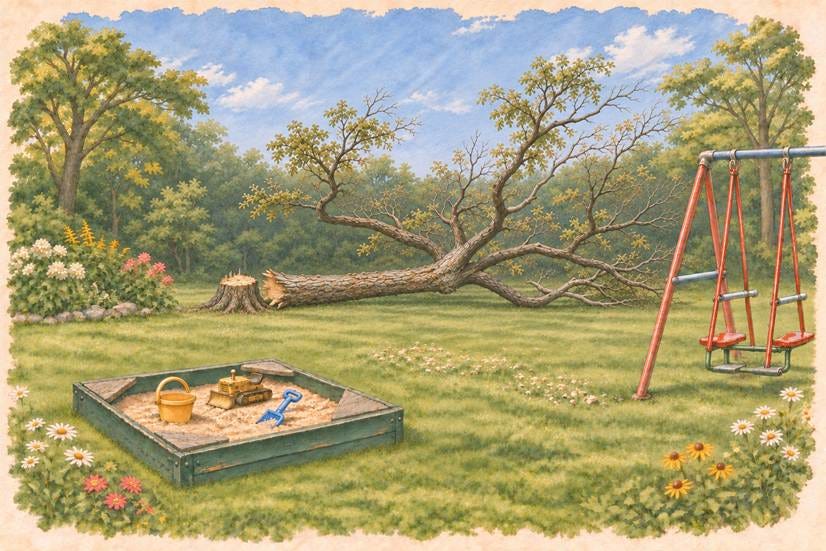
Once it was safely on the ground, I was allowed to go back outside and play in the sandbox. I watched as my father sawed the trunk into smaller logs and split them into firewood, adding the pieces to the woodpile behind the garage. He cut the branches into smaller pieces and stacked them nearby. Eventually, we burned them in a bonfire.
The sky seemed larger without the tree there.
Of all my childhood memories, I’m not sure why I’ve held on to this one.