

As the plane began its final descent into Austin, I stowed my laptop, pulled my phone from the seat-back pocket, and scrolled through photos from the week in LA.
Tango practice.
Greg and me by the pool at the Palos Verdes Beach and Athletic Club.
Laura’s surprise sixtieth birthday party.
And then farther back.
Photographs of Lily that Michael, my oldest son, had texted nearly two weeks earlier.
My granddaughter was four and a half, still in her pajamas, sitting on a huge root of an uprooted tree, the one Michael had told me had come down only feet from their house, with them inside.
In a second photo, she was standing beside the exposed roots of an enormous tree the storm had ripped from the ground. Broken branches and vegetation were strewn around her.
“She was afraid and crying as it was happening,” Michael had told me. “But she understands that she is safe now.”
Michael had texted the photos two days after the storm. I had looked at them then, but I hadn’t seen what I saw now.
I was four and a half the summer an elm tree came down behind my childhood home in rural northern Indiana.
Almost exactly sixty years ago.
That tree was sick and dying, and my father chopped it down with an axe. My mother called me inside before it fell. Afterward, I went back outside and resumed playing in the sandbox beside the fresh stump while my father split the trunk and branches into smaller pieces for the woodpile and a bonfire.
The sky had seemed larger without the tree there.
I looked at the photos of Lily and wondered how much larger the sky behind her house must seem now, with so many of the old trees down in the cloud forest where she is growing up.
What would she remember? What would her life look like sixty years from now?
Thirteen days earlier, the first thing I knew was that Michael was okay.
“Michael’s truck is totaled, but he’s okay,” James had texted.
James and I are in the process of ending a thirty-six-year marriage. We are still legally married, though our lives have been separate for some time. Most of our communication now is about the house we are trying to sell.
When I saw James’s text, my first thought was car accident. Then I remembered seeing something about a hurricane headed toward Hawaii.
It wasn’t quite dark when the text came in, but I’m an early riser, so I was already in bed in the carriage house where I now live in a historic neighborhood in Austin. Mature pecan and oak trees surround it. When I look out the windows from the beamed-ceiling loft where I sleep, I sometimes feel as though I am living in a treehouse.
I called Michael.
He answered on the first ring.
“How are you? Dad texted me that you’re okay, but that your truck is totaled. What happened?”
“Lala. The hurricane. My truck isn’t totaled, but it’s badly damaged. You know that big tree behind our house? It missed us by just a few feet. Our driveway is completely blocked by fallen trees.”
Then he paused. “For a while, I didn’t think we were going to make it, Mom.”
The next morning, Michael texted the photos I would look at again on the flight home from LA. By then, friends and family were already helping him clear the property. The house was still standing. The truck could be repaired. There was damage everywhere, but Michael had what he needed.
He was okay.
There was nothing for me to do.
* * *
A week later, I was in California visiting my boyfriend, Greg, helping to throw a surprise sixtieth birthday party for his younger sister, Laura. She has a debilitating illness and lives in an assisted-living home, where she spends most of her time in bed. Greg was staying in her house, and the party gave her a chance to come home for a few hours.
Greg’s ninety-one-year-old father is also bedridden. He came to the party in his wheelchair. It was the first time he had been out in several months. I helped as Greg attended to Laura, his parents, and the other guests. When the party was over, we cleaned up together. Neither of us had to tell the other what needed to be done. We just kept at it until the house was back in order. It didn’t take long. With Greg, even ordinary things seemed easier.
The next afternoon, we drove to Laura’s assisted-living home with the flowers, cards, and presents from the party and arranged them around her room. She was beaming.
The following morning, Greg and I lingered over breakfast: hard-boiled eggs, Brie, dried cranberries from Trader Joe’s, and rosemary crackers. I had taken a couple of days off work, so there was nowhere we needed to be right away.
Greg had planned something he thought I would like: swimming at the Palos Verdes Beach and Athletic Club. We had discovered early on that we both liked to swim laps. He showed me a picture of the pool with the ocean beyond it.
The week before, I had started writing again after a two-year break. Over breakfast, I told Greg about the essay I was working on, “The Elm Tree.”
During the pandemic, while I was stuck at home, I had written a book about my years supporting Michael through heroin addiction, his recovery, and how I had grown in the process. I worked with an editor and sent a proposal to agents and publishers. No one took it on. Eventually, I set it aside.
“This time feels different,” I told Greg. I wasn’t going to wait for a publisher. I would write essays and publish them on Substack.
On the flight from Austin to LA, I had read Strangers, by Belle Burden. I told Greg how much I admired her courage in writing about her husband’s betrayal.
“I’m going to download it to my Kindle and read it today while we’re at the pool,” he said.
As we headed for Palos Verdes, I realized I had left my phone at the house.
“Can we go back?”
A couple from North Carolina had viewed the house four times in the past week. On their final visit, they had stayed for more than an hour and brought a tape measure. I was sure an offer was coming. Greg pointed out that if one came, it would still be there when we got back. So we didn’t go back for my phone.
As we were parking at the club, I said, “Greg, you know Strangers is a woman’s book.”
I was surprised he wanted to read it.
“I know,” he said. “I want to be on this journey with you.”
The club sits on a cliff above the Pacific. We descended the stairs to the pool, found two chaises, opened an umbrella between them, and settled in for the afternoon.
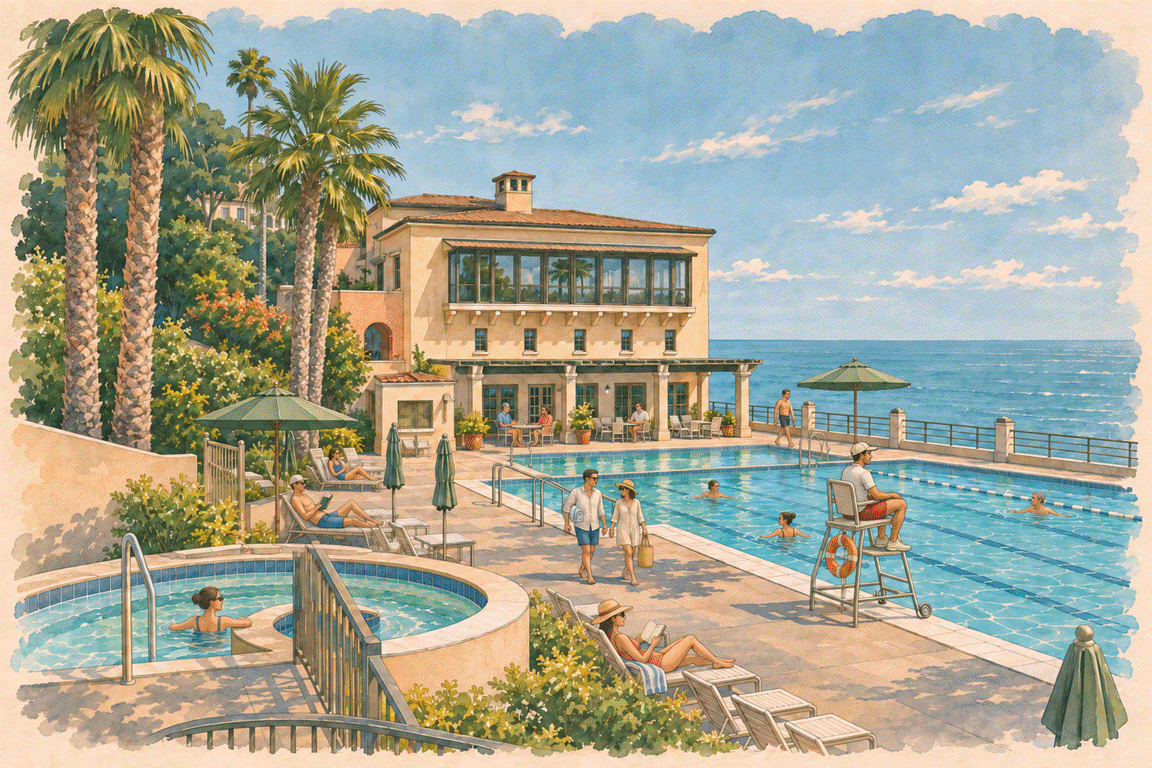
I had my laptop. Greg had his Kindle.
I worked on “The Elm Tree.” He read Strangers.
After a while, Greg looked over at me. “I wonder if the story is true.”
“I think it is,” I said. “Her children might read it, so I don’t think she’d make things up.”
Then he went back to reading, and I went back to my laptop.
If Greg could wonder whether her story was true, what would people make of mine?
An hour or so later, he put aside his Kindle, I closed my laptop, and we swam laps. Afterward, Greg asked a man on a nearby chaise if he would take a few pictures of us with the Pacific as the backdrop.
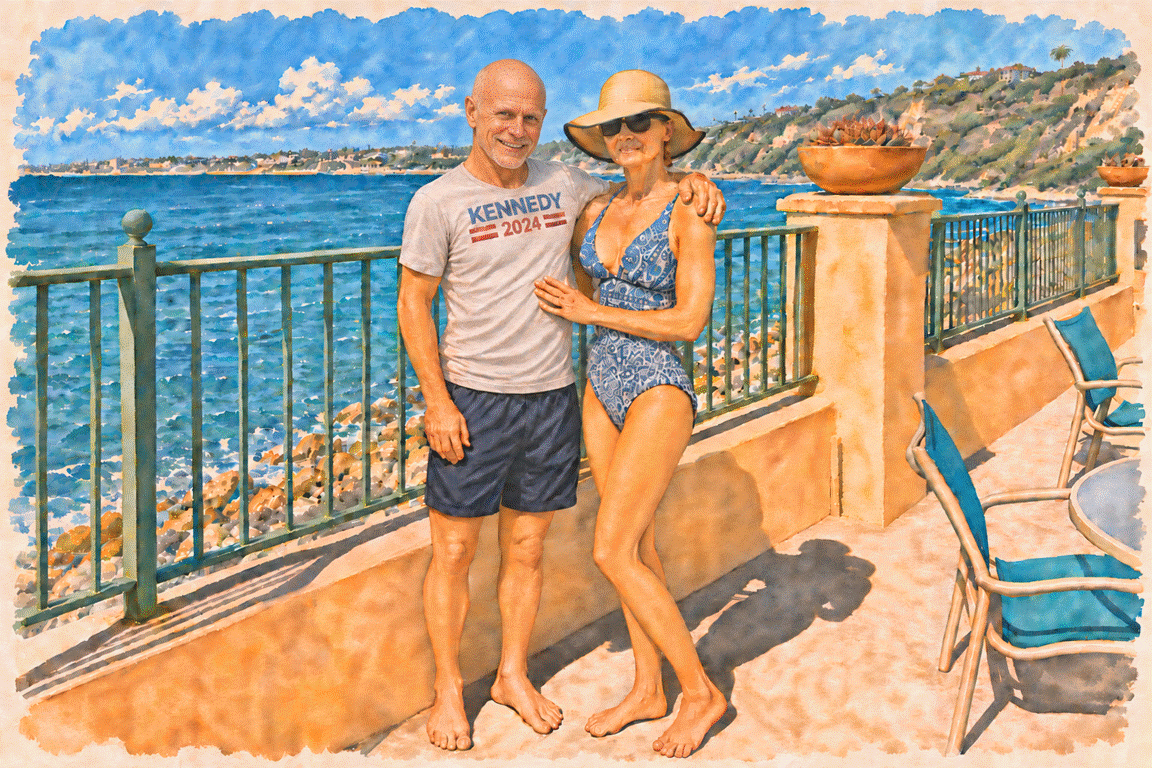
I was in my bathing suit; Greg was in swim trunks and a faded Kennedy 2024 T-shirt.
Not all that long ago, I would never have agreed to photographs of me in a bathing suit.
But at sixty-four, I feel lean and strong. I’ve been practicing yoga for years and have recently become a regular at the early-morning BodyPump classes at the TownLake YMCA in Austin. I am proud of what my body can do.
For the rest of the afternoon, I barely thought about the offer I was sure was coming.
But when we got back to the house, I checked my phone immediately.
No offer.
I was disappointed, but I wasn’t going to let it undo the day. The house would sell when it sold.
Greg made a light dinner.
Over dinner, he looked at me.
“You were really turning me on today in that bathing suit. I don’t know if you noticed, but I couldn’t stop looking at you.”
Until I met Greg, I believed men weren’t interested in older women, but he told me I was beautiful all the time. And I was starting to believe him.
After we finished eating, Greg told me he would take care of the dishes.
“There are some things for you on the bed. Pick the one you want to wear.”
I went into the bedroom and found two camisoles laid out side by side, one pale gray and one soft pink. I chose the pink one. When I came back into the kitchen, Greg was finishing the dishes.
He looked at me and smiled. “I was hoping you’d pick that one.”
Lingerie was new for me. Greg had started giving me things I never would have chosen for myself. Now I buy my own.
We finished cleaning the kitchen together, and then Greg took my hand and led me back toward the bedroom.
Lying next to him later that night, I thought about how good I felt. With Greg, I was finally learning to let go and trust someone completely. I was experiencing something I thought had passed me by.
Learning to dance was part of that change too. The next evening, we went to a tango lesson. I never thought I could dance. Some of that went back to my mother’s Protestant upbringing and the idea that it was somehow wrong. I wasn’t even someone who could have a couple of drinks at a wedding and get out on the dance floor.
But Greg wanted me to try, so I did. He found Ilona, a teacher who was good with beginners. She had turned a freestanding garage in her backyard into a studio, with a wood dance floor and white icicle lights strung overhead.
On her website, she describes tango as a practice in authentic communication: learning to trust and surrender, which was exactly what I wanted.
I was still a beginner, but that night I felt ever so slightly more comfortable and less self-conscious.
The next morning, I realized I hadn’t talked to any of my sons since the call with Michael the evening after the hurricane. That had to be a record.
For years, it would have been almost unimaginable for that much time to pass without one of us calling another. There was always something to worry about, solve, discuss, check on.
And then, as if his ears had been burning, my phone rang. It was Ben, my middle son.
He wasn’t calling because he needed something. He wanted to know if I was up for yoga that evening. Maybe dinner afterward.
When I told him I was in LA, he hadn’t even realized I wasn’t home.
He talked about his new sales job and how well it was going.
There was nothing for me to fix.
My sons didn’t need me the way they used to.
Later that morning, I had my weekly virtual coaching call with Amber Antonelli. I was doing her program, From Patterns to Power, to work on old patterns and beliefs.
Amber and I had met eight years earlier, when she and her husband, Anthony Esposito, ran an iboga retreat center in Costa Rica. At the time, I was desperately searching for a way to help Michael. They would eventually become instrumental in his recovery.
But first, they helped me.
Initially, Michael had no interest in iboga, a powerful plant medicine traditionally used in rites of passage in West Central Africa. More recently, in the West, iboga and its main active alkaloid, ibogaine, have been explored experimentally for both addiction treatment and psychospiritual growth.
The week I spent at Awaken Your Soul in Costa Rica in September 2018 was the most transformative of my life. Amber had been beside me the night I spent under the medicine, puking into a rustic latrine.
And here we were, eight years later, working together again.
“Hey, Mama,” Amber said when she appeared on my screen. “What’s going on with you this week?”
I loved that she called me Mama.
“I’m in California visiting Greg,” I said.
I told her about Laura’s party, the pool at Palos Verdes, and tango practice the night before.
I told her I had started writing again and was going to publish on Substack. I was working on two essays: one about a childhood memory from sixty years ago, and a second about my life as it was unfolding right now, the events of this week. Almost like two bookends for everything that had happened in between.
“Well, you certainly have something to say,” she said.
Then she asked me something I had been thinking about myself.
“What happens if you start getting followers?”
If people actually begin reading, if my writing grows into something, I know I will need help navigating it. I’m not particularly interested in becoming a public person, but I am interested in having a public voice.
From there, the conversation turned to my first iboga retreat. Iboga can induce intense visions, and as part of the process, Amber, Anthony, or one of their guides would lead retreat participants through a series of questions while they were deep in the medicine.
Amber remembered guiding me through the questions during my first iboga ceremony eight years earlier. She reminded me of something I had completely forgotten. In answer to one of the questions, I had described a vision of our kitchen. My three sons were there with me.
James was there too, but apart from us, his back turned.
The vision itself was fuzzy after eight years, but I remembered clearly what our lives were like back then. Ben was in college. Joey, my youngest, was still in high school. And Michael, after doing better for a while, had relapsed.
And Amber told me something I had said that night.
“We are each on our own journey.”
I had no memory of saying it.
Now, sitting in California talking to Amber, I can see how true those words turned out to be. I am no longer desperately trying to save Michael. These days my sons are young men, building lives of their own. James and I live apart, and I no longer hold out any hope that we can somehow make our marriage work.
Amber and I talked about who I am becoming now that my life is no longer organized around crisis, motherhood, my marriage, and what everyone else needs from me.
There was the relationship I was building with Greg. There was tango. There was an unexpected new comfort in my own body.
Amber asked me to think less about what I was leaving behind and more about what I wanted to move toward.
For years, I have imagined a place where families can come together for deep healing work. I don’t know what form that dream will ultimately take, or how I will get there.
But I haven’t let go of it.
* * *
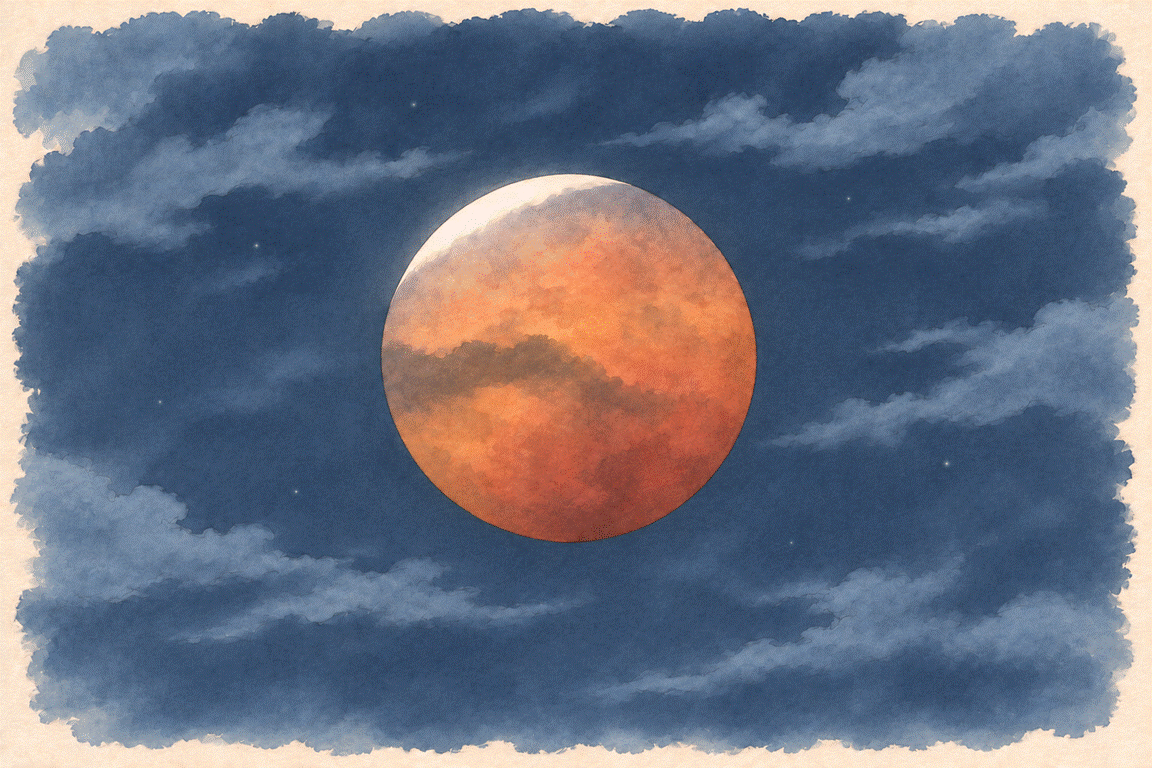
The eclipse over Los Angeles, August 27, 2026.
That evening, Greg and I sat in the backyard to watch a lunar eclipse.
I had been fascinated by the night sky, especially the moon, since I was a child. In rural northern Indiana, I could step outside at night and see a dark sky filled with stars. The sky above Los Angeles was washed with city light, and there was a thin cloud cover, but the moon was still visible as Earth’s shadow slowly moved across it.
Nineteen years earlier, another lunar eclipse had happened at almost exactly the same place in the sky, right where Chiron sits in my birth chart. Chiron, the wounded healer, is about old wounds and how, in time, what we learn from them can become a source of wisdom.
I explained some of this to Greg. He listened.
He didn’t need to believe what I believed for it to matter to him that it mattered to me.
I thought about the woman I had been then and everything that had happened since.
The earlier eclipse fell on my natal Chiron about the time I had first begun working on myself, mostly by reading books about trauma and going to therapy. What I learned back then helped me approach Michael’s addiction with a more open mind. We tried conventional treatments first. When those didn’t work, I started looking elsewhere. That was what took me to Costa Rica for iboga in 2018, before Michael went, and it changed me.
While I don’t believe an eclipse can predict the future, I do like the idea that the sky can mark time, that something can come around again and find me in an entirely different place.
Greg and I sat side by side and watched the moon until only a sliver remained outside Earth’s shadow.
* * *
Two mornings later, Greg was driving me to LAX for my flight home to Austin when Joey called. I hadn’t talked to him since he started medical school three weeks earlier.
“Hey, Mom.”
“Hi, sweetie. I’ve been in California this week. I’m on my way to the airport now.”
Joey said his first exams were coming up. He told me how quickly everything was moving. Material that had previously taken an entire semester was now compressed into a single lecture.
“I’ve started writing again,” I told him.
“That’s good. I know you like to write,” he said.
I told him I was thinking about publishing some of it on Substack, but that I planned to use pseudonyms, and that I wouldn’t write about the drama of our lives simply for the sake of drama. I would only include what served the story.
“Yeah,” he said. “Please don’t use my real name.”
I laughed.
“I won’t. I promise.”
Like Ben two mornings earlier, Joey had called just to talk.
My sons are living their lives. And I am figuring out what comes next in mine.
The house still hasn’t sold. My marriage isn’t officially over. I have no idea where things with Greg will lead, whether anyone will ever read what I am writing, or whether my dream of a place for families to heal will ever become real.
For most of my life, I believed I needed to know where things were going before I could trust myself to move toward them.
I’m writing from the middle of the story now.
And for once, I don’t need to know how it ends.